
Laurie Laker: Soccer and Community In Icy Conditions
If you are interested in donating to the resources that the Twin Cities Gooners are collecting for those affected in the Twin Cities area, you can learn more here
My name is Laurie. I’m a lifelong Arsenal supporter from England, now living in Minneapolis–Saint Paul. I serve on the board of Arsenal America, and I’m the Branch Manager of our local supporters group, the Twin Cities Gooners. Prior to my time here in the Twin Cities, I was the founding Branch Manager for the Pikes Peak Gooners in Colorado Springs, CO, a member of the U.S. Soccer’s Diversity Task Force, and I’ve spent over a decade working, volunteering in, and being a part of the national and global sport-for-development community with organizations like Grassroot Soccer, Soccer Without Borders, Special Olympics, and more.
Arsenal and this football club runs in my blood. I’m a third generation supporter, or fourth depending on who you ask, with former players and fans across the entire root and branch system of my family tree. It’s a huge part of my life, and it’s never been more important to me than it is at this moment. Like so many of us, I have found a profoundly impactful, welcoming, and formative community through the club they follow. For me, Arsenal has always been more than football — it’s been belonging.
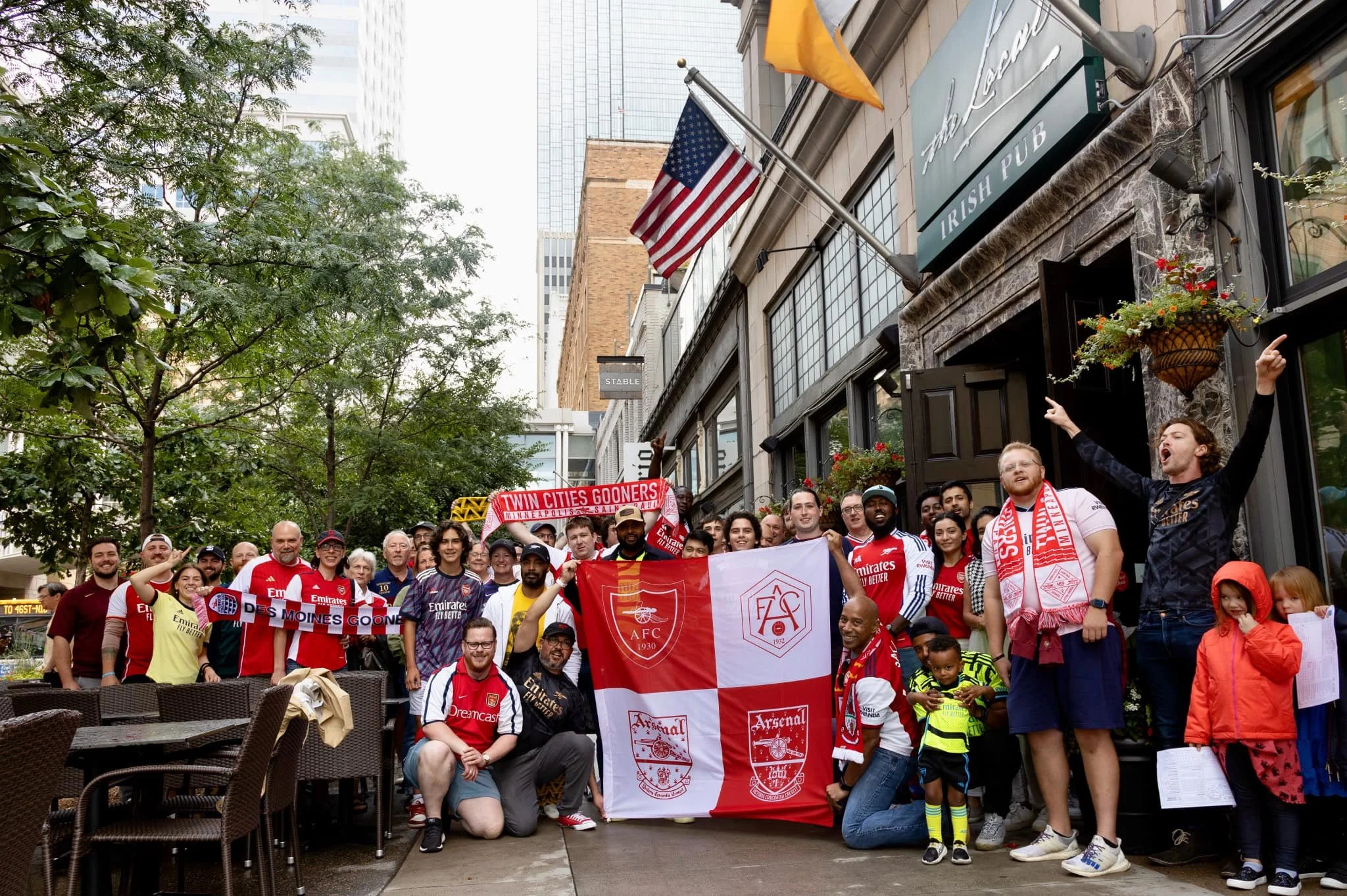
I’ve been lucky enough to live all over the U.S. and in multiple countries, and the common theme in all of those spaces and communities has been football. Here in the Twin Cities, a part of the world I’d never even thought of visiting until my partner and I made the decision to move here nearly 5 years ago, finding and linking into an Arsenal America branch was tantamount to a requirement for socio-cultural survival for me. The moment I walked into the branch pub, The Local in downtown Minneapolis, I exhaled and felt my shoulders drop. I was home. Even in a foreign space, in a city I didn’t know, surrounded by faces I’d never seen before. To have now become a leader of that group, that’s an honor I will never, ever take lightly.
For those who may not know — and as I’ve come to learn in my years of living here — the Twin Cities is a unique set of communities within communities, generations of identities built alongside and in concert with each other. We’re not a perfect place, and we have significant issues to address in our culture, systems, communities, and across our numerous diasporas and identities. But we are a community, and in times like these — more on that shortly — that matters so, so much.
Our Arsenal America branch is one that many leaders and supporters have built over almost 15 years, and is a group set across borders, languages, faiths, and backgrounds. Our matchgoing attendees reflect the reality of our region. We are made up of Somali, Ethiopian, Mexican, Chilean, Colombian, Brazilian, Turkish, Ghanaian, Kenyan, British, European, American and more — immigrants, expats, refugees, first-generation kids, and people who’ve lived here their whole lives. Arsenal is for everyone, as long as you embrace our multitudinousness, especially in a place like Minneapolis–Saint Paul.
So, why am I writing this piece for the Heart of a Fan Substack?
Well, I know Matt from our work together on the early iterations of Heart of a Fan — an initiative that began as part of his graduate dissertation at Northeastern University, many years ago. He sought me out as an interview subject for his research, and from there we’ve struck up a professional and personal friendship. Ever since that early discussion, we’ve talked and collaborated on ideas that center sport as more than entertainment. We’re both passionate about how fandom becomes community, how supporter culture is grown and not manufactured, and how spaces where sport is a centrifuge around which ideals of welcome, inclusivity, and collectivism spin. We also both follow the same mad, infuriating, brilliant football club — the aforementioned Arsenal F.C., and our weekends and weeks are shaped incurably by whether 11 millionaires successfully kick a ball into a net.
More immediately, I’m writing this because he asked me to. Given current events, he reached out to me as a friend to check in, and then we just landed on the fact that most people are barely seeing the scale, scope, and true depth of invasion, fear, and terror that our Twin Cities are living with day and night. Perhaps more importantly, they’re not seeing the metro-wide level of community support, engagement, and resistance to the hostility we’re being subject to.
This isn’t by any means the full truth or scope of what’s happening. As I said, I’m a white CIS-genedered male so I cannot stress enough how much I am not under direct threat. My friends, neighbors, local residents of color, who sound or look “different” to me - they are the ones being rounded up, hounded, assaulted, abused, and threatened. That’s why solidarity and collective support means so much to us - from across the street or the other side of the world - every voice shouting back against this matters, because it tells us living through this that they care.
Right now, that care matters more than ever.
As you’ve likely seen the news, over the last few weeks, our community has been living under a sustained and very direct pressure, threat, and invasion-style occupation. A federal immigration operation known as “Operation Metro Surge” has brought 3,000 or more armed ICE, CBP, and CHS agents into the Twin CIties and Minnesota at-large. These agents are trawling neighborhoods, transit hubs, schools, churches, scoping out shopping districts or areas with a high rate of international restaurants, targeting people of color, protestors, and legal observers with harassment stops, arrests, or far, far worse. What had been scattered raids towards the back end of last year has morphed into a heightened and outwardly hostile movement of force against the people, so much so that people who even step outside feel the tension on the quietest of streets. Why? Because that quiet can be shattered like the most fragile of glass by a burst of whistle alert fire, denoting the presence of those unwanted agents.
People in immigrant neighborhoods watch for unmarked vehicles, SUVs, and masked officers. Parents talk about struggling with the decision to send their children to school — arrests are being made on bus routes — and U.S. citizens are being ripped from cars, aggressively questioned, or worse for even being in proximity to the agents. Our local law enforcement leaders have raised alarms repeatedly about agents stopping those most vulnerable in our communities, even their own officers being threatened with weapons and demanding proof of right to be in the U.S.
The two tragedies we’ve seen first-hand, the murders — fatal shootings if we’re being legally correct for the time being — of Minneapolis residents Renee Good and Alex Pretti have only intensified fear, outrage, and anger. In both cases, community members here have had a hard time reconciling administration response and reports with what we saw with our own eyes, both in-person and on camera. We are being told to not believe our eyes, to buy the lie. We are refusing to do so, because we all know what we saw.
I want to be clear about my own position at this moment. I am an immigrant — but I am also a white, cisgender man. I am not who ICE is targeting. And yet, even I am carrying copies of my passport and my naturalization certificate with me. That fact alone should tell you something about the climate we’re in. The tension, fear, and very real danger we’re all being placed in — every day, by the presence of these people in our communities.
Two year olds taken and detained. Five year olds used as “bait” to get to their parents. Teachers tear gassed. Observers beaten and arrested with no charge. This isn’t abstract. This is lived reality. It’s trauma unfolding in real time, in a community that has had more than its fair share of such horrors over the last decade.
In some way, that’s one of the cruelest positives to come from this. Because of the horrors that these cities have endured at the hands of authorities, these communities have deep-rooted activist and community solidarity networks. Trained behaviours and practices to rely on for outreach, support, and collective action. These people chose to come to the home of winter, in January, and try to fight a battle against communities that have already won many of these wars. Yes, this is terrible, beyond harrowing. But my god, did they make a mistake in targeting us here.
The North Remembers. It will not forget and it will not break.
What role, if any, does a football club’s supporter group have in this fightback, in the work of uplifting and supporting those at most risk in our communities — the same folk who we cheer and sing alongside with every week at our pub, those who we’ve not seen in many weeks because it’s just too dangerous for them to venture into certain areas given their background, ethnicity, or accent. How do we help those who make us who we are?
Collectively, given our group dynamic, we decided to dive headlong into a donor-match fundraising challenge to support organizations that are doing immediate, on-the-ground work to protect and defend our neighbors. We’re supporting four such organizations, and are so proud to be doing so. These groups provide legal defense, advocacy, rapid response, and direct support to people at immediate risk. This isn’t charity from a distance. This is a community protecting itself in real-time to address immediate needs. They are as follows:
Unidos — a grassroots organization that builds power with Minnesota's working families to advance social, racial and economic justice.
Immigrant Defense Network — a community resource hub, immigration policy watchdog, and engine for rapid response to violations of immigrant rights & due process
CAIR-MN — Minnesota’s leading Muslim civil rights and legal advocacy organization
Immigrant Law Center — a nonprofit organization that provides free immigration legal representation to low-income immigrants and refugees in Minnesota and North Dakota
Our initial target as a fundraising goal was $490.49, with our branch matching donations up to that Invincibles-inspired total.
As of the morning of January 27 — just over two weeks after we began fundraising in the wake of Renee Good’s killing — we’ve raised over $12,000 that is going directly back into our community and helping those at most risk or with the most need.
What we’re doing doesn’t stop at fundraising and giving money. We’re also taking practical steps to help our community members feel safer in their day-to-day lives. At our watch parties, we’re handing out whistles and alert use guides. We’re directing members towards trusted, up-to-date “Know Your Rights” resources so people understand what protections they have and what to do if they’re stopped or questioned. We’re offering virtual matchday watchalongs to help everyone engage with our events, if they feel unsafe to do so in-person. Staying connected to your community should never come at the cost of your personal safety.
As Arsenal fans and supporters, we are acutely aware of the club’s commitment to making communities as welcoming, inclusive, strong, and safe as possible. Our club has a long history of positive community impact, and we are doing our part to keep that mission alive with our own efforts to support those most at-risk in our suburbs, our neighborhoods, and our cities.
Those values don’t stop at the gates to The Emirates in North London or on the streets of Islington. They transfer. They transmit. They travel.
They are with us here in the Twin Cities. On the streets of Minneapolis and Saint Paul, across the suburbs of our metro area, and beyond.
We’re living those values.
One day, one matchday moment and beyond, at a time.
Victory Through Harmony.